Mary Meeker's annual Internet Trends Report is always a treasure trove of data about digital. This year's just-released report is no exception.
The video may be a bit long for class, but you can find the PPT with all the data on the Kleiner Perkins website.
Related Content
eMarketer comments on some of the important trends highlighted in the report

Thursday, June 13, 2019

Sunday, March 3, 2019
Impact of the GDPR After Almost a Year
I wrote about the GDPR just before it went into effect. Almost a year has passed and it’s time to look at the actual impact it is having.
How Important is the GDPR 10 Months In?
The EU General Data Protection Regulation (GDPR) is the most important change in data privacy regulation in 20 years. That statement is from the EU’s own information portal, which goes on to say that, The regulation will fundamentally reshape the way in which data is handled across every sector, from healthcare to banking and beyond. What that statement doesn’t say is that it will also fundamentally reshape the way in which data is handled in countries outside the EU including the US. If you want a quick overview of the sweeping changes mandated by this law see the Key Changes page on this site. An earlier post reviewed the implications of the law from the perspective of US brands.
What Are the Main Issues of GDPR Compliance?
The GDPG mandates a strong set of protections for consumers and their data as shown in a section of the original infographic. Publishers were expected to comply with these requirements by the time the law went into effect.
The GDPR took effect in May 2018 so its impact on marketing organizations is becoming clear. In order to plan their compliance with the GPDR organizations were advised to:
• Conduct a complete audit to find out how much customer data was collected throughout the organization. Most were surprised by how many data items were being collected and how many different groups in the organization were collecting them.
o This led to the identification of much ROT (redundant, obsolete and trivial) data. By one estimate 70% of data in most organizations is ROT and should be eliminated.
• Appoint a data protection officer. That is a requirement of the law.
• Review and update privacy policies and statements. That includes an assessment of how permission is obtained and managed.
• Review data security policies for compliance with the law. That includes not only keeping customer data safe but also making it accessible to review and correct.
• Have procedures in place to promptly report data breaches.
• Make sure that everyone in the organization who has any contact with data is fully informed about GDPR requirements.
This short list indicates that compliance with GDPR is no small issue. As stated in the earlier post most companies were not prepared and have had to spend the last 10 months scrambling to catch up.
What Happened When the GDPR Was Implemented?

As had been predicted since its passage, relatively few businesses were fully compliant when the law went into effect in May 2018. As shown in the eMarketer chart it may not be surprising that the fewest firms in the US were fully compliant and the most hadn’t even started.
My personal favorite headline: “Facebook and Google Accused of Violating GDPR on First Day of the New European Privacy Law,” from Gizmodo. Since then:
• France fined Google $50 million for violating requirements for obtaining explicit consent.
• The EU fined Google $5 billion for anti-competitive activities involving the way in which it required manufacturers to install Google apps on Android phones.
• Germany alone has issued 41 smaller fines charging Google with various GDPR violations.
• Facebook was fined $644,000 for leaking data in the Cambridge Analytica scandal.
• A data breach that affected the access tokens of more than 50 million Facebook users could result in a fine of $1.63 billion.
• In February 2019 ITPro reported that Facebook was the subject of 10 major GDPR investigations.
The amounts of the potential fines vary by type and location. The largest can be $23.6 million at the time of writing or 4% of the total worldwide annual turnover (sales). That accounts for potential fines in the billions of dollars. Smaller companies obviously will not face fines of this magnitude but they can still be devastating. Perhaps even more important for small firms, they do not have the legal and IT resources the larger businesses can rally to comply with the law and to fight charges of violations.
The effect of GDPR is felt in more ways than fines, and some of those could have major impact on marketing activities. Digiday lists 5 marketing impacts and has charts to support them. They are:
1. The use of third-party cookies has decreased. The study covered only news sites.
2. Marketers are concerned that their martech applications may not be compliant with the requirements.
3. Contextual targeting has increased due to issues of using third-party targeting data.
4. Smaller companies, including techs, are struggling with the requirements.
5. US publishers are still holding back, waiting to assess the impact of the law.
Business applications that depend on AI, from self-driving cars to customer service, may find their efforts frustrated by data issues. Innovation across the board could be inhibited. Digital business models may be invalidated.
Customers may find the opt-in requirements frustrating and may see free services, supported by their data at present, disappear. At the same time, customers are becoming more aware of privacy issues and the value of their data.
The GDPR may stimulate more data protection efforts. California and Vermont have already passed data privacy laws that have broad implications. These efforts may affect consumers and data protection efforts in other states. Tech companies and publishers alike would find it difficult to comply with a patchwork of different laws in different states.
What Does the GDPR Future Hold?
The only thing that seems entirely clear is that there are potential positive impacts of GDPR and potential negative impacts for both business and consumers.
EU Competition Commissioner Margrethe Vestager has strong words for consumers: "There is no such thing as a free lunch. You pay with one currency or another—either cents, or you pay with your data, or you pay with the advertisements that you accept. And I think people are becoming more and more aware of the fact that their personal data do have a value."
A European security publication has another great headline that pretty much sums it up in these early days--The Future of GDPR - Dead, Diluted, Detested or Accepted? It could die “a slow, bureaucratic death,” be modified by the regulatory agencies, become the focus of voter ire, or gradually become an accepted part of the regulatory landscape; seen as necessary, perhaps even desirable
So the future is unclear with many battles to be fought on behalf of both businesses and the public. One thing is clear: it would be a great step forward if the discussion of data privacy issues could begin with the best interests of consumers and society as the central focus, but that may be too much to expect.
In this context it might be useful to review earlier posts about the data-related issues faced by the duopoly:
• Facebook
• Google
Related Updates:
Amazon also under scrutiny about use of partner data
Results after a year from Slate
Pros and cons from CNBC
Where GDPR goes from here
Cookie use, email marketing and PECR
How Important is the GDPR 10 Months In?
The EU General Data Protection Regulation (GDPR) is the most important change in data privacy regulation in 20 years. That statement is from the EU’s own information portal, which goes on to say that, The regulation will fundamentally reshape the way in which data is handled across every sector, from healthcare to banking and beyond. What that statement doesn’t say is that it will also fundamentally reshape the way in which data is handled in countries outside the EU including the US. If you want a quick overview of the sweeping changes mandated by this law see the Key Changes page on this site. An earlier post reviewed the implications of the law from the perspective of US brands.
What Are the Main Issues of GDPR Compliance?
The GDPG mandates a strong set of protections for consumers and their data as shown in a section of the original infographic. Publishers were expected to comply with these requirements by the time the law went into effect.
 |
| https://www.pinterest.com/pin/342273640423081936/ |
The GDPR took effect in May 2018 so its impact on marketing organizations is becoming clear. In order to plan their compliance with the GPDR organizations were advised to:
• Conduct a complete audit to find out how much customer data was collected throughout the organization. Most were surprised by how many data items were being collected and how many different groups in the organization were collecting them.
o This led to the identification of much ROT (redundant, obsolete and trivial) data. By one estimate 70% of data in most organizations is ROT and should be eliminated.
• Appoint a data protection officer. That is a requirement of the law.
• Review and update privacy policies and statements. That includes an assessment of how permission is obtained and managed.
• Review data security policies for compliance with the law. That includes not only keeping customer data safe but also making it accessible to review and correct.
• Have procedures in place to promptly report data breaches.
• Make sure that everyone in the organization who has any contact with data is fully informed about GDPR requirements.
This short list indicates that compliance with GDPR is no small issue. As stated in the earlier post most companies were not prepared and have had to spend the last 10 months scrambling to catch up.
What Happened When the GDPR Was Implemented?

As had been predicted since its passage, relatively few businesses were fully compliant when the law went into effect in May 2018. As shown in the eMarketer chart it may not be surprising that the fewest firms in the US were fully compliant and the most hadn’t even started.
My personal favorite headline: “Facebook and Google Accused of Violating GDPR on First Day of the New European Privacy Law,” from Gizmodo. Since then:
• France fined Google $50 million for violating requirements for obtaining explicit consent.
• The EU fined Google $5 billion for anti-competitive activities involving the way in which it required manufacturers to install Google apps on Android phones.
• Germany alone has issued 41 smaller fines charging Google with various GDPR violations.
• Facebook was fined $644,000 for leaking data in the Cambridge Analytica scandal.
• A data breach that affected the access tokens of more than 50 million Facebook users could result in a fine of $1.63 billion.
• In February 2019 ITPro reported that Facebook was the subject of 10 major GDPR investigations.
The amounts of the potential fines vary by type and location. The largest can be $23.6 million at the time of writing or 4% of the total worldwide annual turnover (sales). That accounts for potential fines in the billions of dollars. Smaller companies obviously will not face fines of this magnitude but they can still be devastating. Perhaps even more important for small firms, they do not have the legal and IT resources the larger businesses can rally to comply with the law and to fight charges of violations.
The effect of GDPR is felt in more ways than fines, and some of those could have major impact on marketing activities. Digiday lists 5 marketing impacts and has charts to support them. They are:
1. The use of third-party cookies has decreased. The study covered only news sites.
2. Marketers are concerned that their martech applications may not be compliant with the requirements.
3. Contextual targeting has increased due to issues of using third-party targeting data.
4. Smaller companies, including techs, are struggling with the requirements.
5. US publishers are still holding back, waiting to assess the impact of the law.
Business applications that depend on AI, from self-driving cars to customer service, may find their efforts frustrated by data issues. Innovation across the board could be inhibited. Digital business models may be invalidated.
Customers may find the opt-in requirements frustrating and may see free services, supported by their data at present, disappear. At the same time, customers are becoming more aware of privacy issues and the value of their data.
The GDPR may stimulate more data protection efforts. California and Vermont have already passed data privacy laws that have broad implications. These efforts may affect consumers and data protection efforts in other states. Tech companies and publishers alike would find it difficult to comply with a patchwork of different laws in different states.
What Does the GDPR Future Hold?
The only thing that seems entirely clear is that there are potential positive impacts of GDPR and potential negative impacts for both business and consumers.
EU Competition Commissioner Margrethe Vestager has strong words for consumers: "There is no such thing as a free lunch. You pay with one currency or another—either cents, or you pay with your data, or you pay with the advertisements that you accept. And I think people are becoming more and more aware of the fact that their personal data do have a value."
A European security publication has another great headline that pretty much sums it up in these early days--The Future of GDPR - Dead, Diluted, Detested or Accepted? It could die “a slow, bureaucratic death,” be modified by the regulatory agencies, become the focus of voter ire, or gradually become an accepted part of the regulatory landscape; seen as necessary, perhaps even desirable
So the future is unclear with many battles to be fought on behalf of both businesses and the public. One thing is clear: it would be a great step forward if the discussion of data privacy issues could begin with the best interests of consumers and society as the central focus, but that may be too much to expect.
In this context it might be useful to review earlier posts about the data-related issues faced by the duopoly:
Related Updates:
Amazon also under scrutiny about use of partner data
Results after a year from Slate
Pros and cons from CNBC
Where GDPR goes from here
Cookie use, email marketing and PECR
Friday, February 8, 2019
We All Need to Be Aware of Phishing Emails

Phishing is a disgusting scam that is discussed in Chapter 17. The FBI's 2017 internet crime report identified over $675 million in losses from this type of cybercrime.
I hope most institutions have beefed up their security against these emails since the days when I used to regularly report emails to IT that my colleagues apparently ignored. My sense also is that my students were not very careful. Perhaps they were even gullible, especially to the "something for nothing" offers.
Whether you approach this subject from a personal perspective or from a business one, it is important. I think the updated information in this new post will be helpful. You could even use the Google test in class as an engagement device.
Wednesday, February 6, 2019
Cell Phones and Data Protection
We all use our cell phones at all times in all sorts of places. In my experience our students can be extremely careless of their data security in general and their cell phone security in particular.

I've just posted a link to the article with this excellent 2+ minute video on my privacy blog. It's perfect for use in class.
Just beneath it there's a good post (if I do say so myself :) on the major security threats in 2019 which would also provide content for a good class update.
Enjoy--and stay safe!

I've just posted a link to the article with this excellent 2+ minute video on my privacy blog. It's perfect for use in class.
Just beneath it there's a good post (if I do say so myself :) on the major security threats in 2019 which would also provide content for a good class update.
Enjoy--and stay safe!
Thursday, January 24, 2019
Great List of Resources for Teaching Digital Marketing

Prof. Jeannine Morber of Stevenson University has put together an extensive and well-curated list of resource sites for Digital and Social Media Marketing instructors.
Debra posted the list on her blog and also posted a Google Doc with the list if that is more convenient for you.
Do check it out!
And thanks to Jeannine for making it available!!!
Thursday, January 3, 2019
Digital Disruption in 2019
Happy New Year! I recently found an infographic that provides an interesting summary of continuing digital disruption in 2019. I went a little further and annotated it with some useful posts and reports. Hint: getting this so it was lined up and readable on a blog page was definitely not worth the trouble! And, of course, the links weren't live, so I've put good ones at the end of each section. I think you'll find ideas, data and graphics you can use in your classes in the coming months. The original infographic now seems to be behind a subscription wall, so I'm glad I captured it.


IoT outlook in the US
IoT from a global expert with a good graphic
Privacy issues as seen by both consumers and businesses with link to Economist white paper
Updates--2019 predictions from marketers

Accenture's 2018 report on disruption
Post on chatbots including customer service applications
New report discusses use of social media in customer service

One outlook on effects of AI on marketing jobs
Look ahead at mobile in 2019 has good data

IoT outlook in the US
IoT from a global expert with a good graphic
Privacy issues as seen by both consumers and businesses with link to Economist white paper
Thursday, December 20, 2018
Good, Integrated Use of Digital Marketing
One of the few reality shows I've ever gotten hooked on was the Beekman Boys. Sadly, it's been off the air for two or three years. I was enchanted by the two guys from NYC who bought a farm in Vermont, bonded with their neighbors and animals (goats, pigs and a runaway llama) and struggled successfully to create a sustainable business. Episodes of the show are posted online; just Google them.
Brent is a physician with an MBA who worked for Martha Stewart Omnimedia and Josh is a former executive at the JWT agency, so maybe it should be no surprise that they have a sophisticated marketing strategy that uses various media channels. I was delighted to reconnect with them on HSN.
Earlier this month I saw a link to their 24-hour marathon (!!) on Facebook. I watched a little of it and it was a delight. This video would be a good launch for a class discussion of how to engage with your customers!
They also have a charming website, a retail store (featured on the site) and a Facebook page with 191 thousand followers in addition to their frequent appearances on HSN. A true omnichannel strategy!
There's lots of opportunity for discussion here, especially about the ways in which they integrate the various channels. It would make a great mini-case if someone had the energy to write it up and share it with the rest of us!
In the meantime, Happy Holidays!!!
Brent is a physician with an MBA who worked for Martha Stewart Omnimedia and Josh is a former executive at the JWT agency, so maybe it should be no surprise that they have a sophisticated marketing strategy that uses various media channels. I was delighted to reconnect with them on HSN.
 |
| http://bit.ly/2EE961B |
Earlier this month I saw a link to their 24-hour marathon (!!) on Facebook. I watched a little of it and it was a delight. This video would be a good launch for a class discussion of how to engage with your customers!
They also have a charming website, a retail store (featured on the site) and a Facebook page with 191 thousand followers in addition to their frequent appearances on HSN. A true omnichannel strategy!
There's lots of opportunity for discussion here, especially about the ways in which they integrate the various channels. It would make a great mini-case if someone had the energy to write it up and share it with the rest of us!
In the meantime, Happy Holidays!!!
Saturday, November 24, 2018
The Power of Instagram Stories
Why is Instagram a Marketing Powerhouse?
Instagram has become indispensable to many marketers for the usual reasons--it's large and it's effective in reaching and motivating attractive target audiences. Some 2018 statistics to back that up:
- It has 1 billion active monthly users as of mid-2018. Yes, that's billion with a b!
- Its growth is expected to continue, as compared to Facebook, Twitter and even Snapchat, all of whose growth in number of accounts has plateaued.
- Instagram users spend an average of 53 minutes each day on the Android version of the app.
- Of primary importance to marketers, it is the platform of choice of 18 - 34 year-old consumers worldwide, a notoriously hard to reach demographic.
 |
| https://www.statista.com/statistics/248769/age-distribution-of-worldwide-instagram-users/ |
- 1/3 of US mobile users are on Instagram.
- 25% of US mobile male users are on the platform.
- 40% of US mobile female users are on it. Note that worldwide slightly more men than women are on the platform,
- Their usage is formidable:
- 22% of users log in to Instagram at least once each day.
- 38% check their account multiple times each day.
- 63% of US teenagers use Instagram daily.
- 34% of US Millennials use the platform daily.
- 72% of users have purchased a product they saw on Instagram.
Instagram is a Proven Business Platform
As users have flocked to Instagram, brands have followed them there. The platform works equally well for global brands and small local businesses. And it does work. According to Hootsuite's aggregation of stats:
- 16.71% of businesses use Instagram; there are 17.25 million business profiles on the platform.
- It has 18.2 million monthly advertisers.
- 19.8% of users follow at least one business.
- 60% of users discover products there.
- 75% of users take some kind of action like visiting a product's website.
- In a single month 1/3 of Instagram users purchased a product using a mobile device making them 70% more likely to purchase from a mobile device than non-users.
- Instagram has a 2.2% interaction rate, higher than competing platforms.
- In a single month in 2017 50% of Instagram business accounts produced at least one Story.
What Are Instagram Stories?
 If Instagram is a marketing powerhouse Instagram Stories is the feature that is propelling its current growth. Instagram Stories is a feature that allows users to post photos and videos that disappear after 24 hours. Snapchat was the first to introduce Stories in 2013 and now Facebook offers the feature also. Instagram quickly outstripped the popularity of both Facebook and Snapchat stories among the key young adult demographics.
Once the Stories feature has been activated on the app, all the content posted during a 24-hour period is shown in chronological order. Content from the user's camera roll can be included. The story appears on a bar at the top of the creator's page. Stories can be shared with other users but there are no likes or comments. Stories also offers a number of engagement features--stickers, locations, hashtags and polls appear to be the most popular. In order to access these features the user must convert to a business profile. If you are converting a personal profile to a business profile, you may need to change some of your settings to activate all the new features. Once you have Stories operational, you can create your first Story.
Because of the ephemeral nature of Stories, sharing options are limited. Instagram posts can be shared to a user's Story by using the paper plane icon. Stories can be reposted by accounts but only if they are tagged in another account's Stories. Reposting is useful for brands that use influencer marketing because they can include the influencer's post in their own highlights.
HubSpot lists other useful business features:
- Business that have over 10,000 followers can add links to their Stories, thereby driving viewers to their websites.
- The Highlights feature allows businesses to add a set of clips to their profile. Highlights do not disappear after 24 hours; they remain visible underneath the profile picture until the brand deletes them.

- Instagram Stickers can be customized to increase engagement and add a call to action. See examples here.
How Brands Use Instagram Stories

Brands use Instagram Stories to promote their products and services in many ways, as shown in this chart from marketing services firm Launch. Their report says that Instagram is the best platform for creating viewer engagement and that brands value engagement even more than they do product awareness. Makes sense--engagement has a good chance of leading to viewer action.
Brandwatch posted an infographic with compelling reasons to use Stories and links to 30 interesting case histories. Unfortunately it's just too long to post, but here's the link. Some of their statistics are already outdated. I've been careful to use the most recent ones I could find for this post. Here are some capsules of brands who are using Stories well.
 Selena Gomez. Not a brand, you say? To my mind anyone who has 144 million followers on Instagram is a brand, whether she intended it or not. And I assume this former girlfriend of Justin Bieber did intend it. I've read the Vanity Fair article on how she became the top Instagram celebrity and I still don't understand it. But that's ok because I'm not part of her target audience. She does Stories, of course; this is simply her profile picture.
Nike. Always a powerhouse in digital, there are literally dozens of Nike Instagram accounts. Some are corporate accounts, some are retailer accounts and some may even be individual fans. This is from #Nike, which features user-generated content. I captured this shot from the Black Friday story because it has an interactive feature, a question sticker, I think.
 It turns out to be a post from Turkey's largest retailer of sportswear. What fun!
[accessed November 23, 2018]
Monterrey Bay Aquarium. National Geographic is far and away the leader in this space with 94.3 million Instagram followers as I write this. It has been an internet and social media giant from the beginning with its captivating photos. The Monterrey Bay Aquarium, with 'only' 253 thousand followers, shows much smaller non-profit using Stories well. Any account that can host a #SeaSlugDay has my vote. It also has my vote for having an Instagram account just for teens to post their own content for other teens. That's a great fit with their mission "to inspire conservation of the ocean" and their program "to inspire the next wave of ocean leaders" by focusing on education and development programs for children, teens and teachers.
[accessed November 23, 2018]

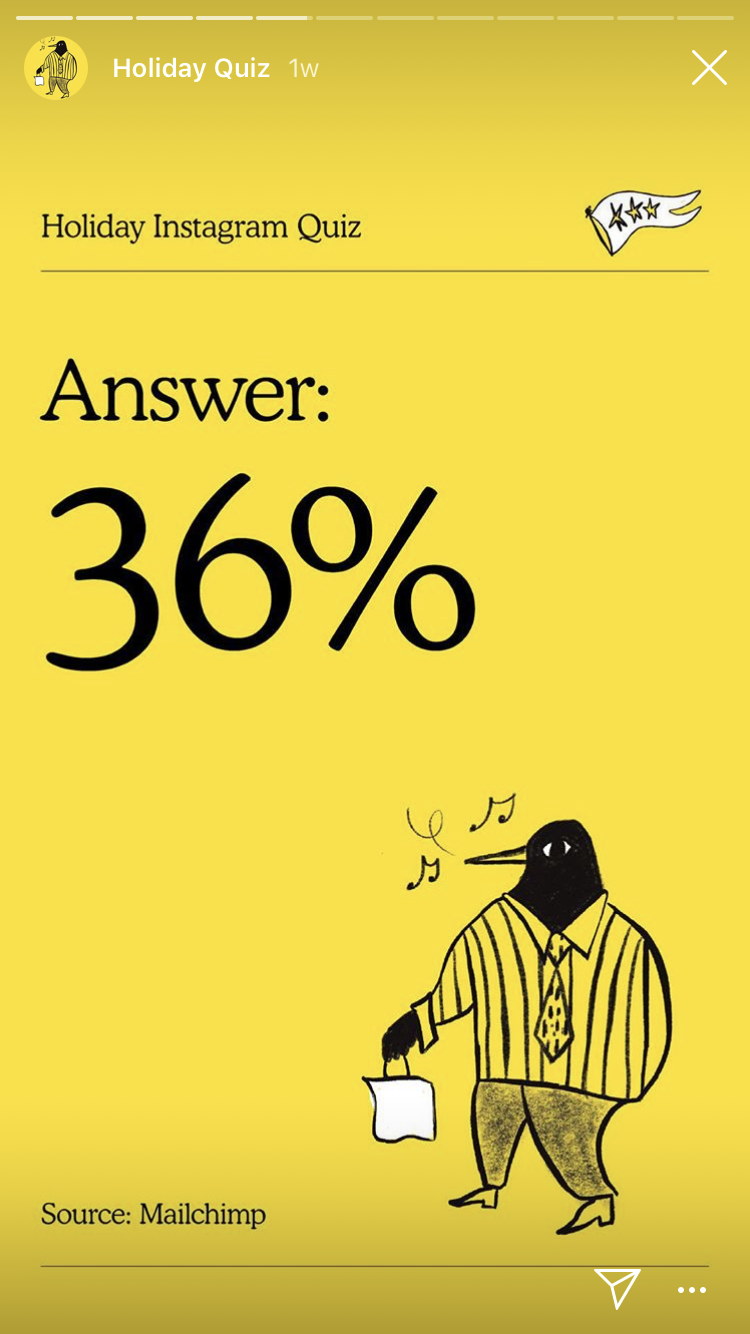

Mailchimp. When you search the best B2B Instagram marketers email marketing firm Mailchimp invariably shows up. These three screens from their Small Business Saturday Story gives a good idea of why. Interactive features promote engagement and the answer, of course, is a promo for Mailchimp's services. They have 87.7 thousand followers, which is not too shabby for a marketing services firm unknown outside the email industry. They have one service that is especially relevant--the ability to create an Instagram (also Facebook) ad directly from their platform. The process is explained thoroughly without the viewer having to create a Mailchimp account. The third resource page Create Instagram Ads in Mailchimp has a 2-minute video that would work well in the classroom. Wow!
[accessed November 24, 2018]
This is more than enough to give you the idea! A word of warning, however. It's difficult to do justice to ephemeral content in a static context. Instagram Stories beg to be shown in class. You can find good sources in the Brandwatch infographic post or a more recent article in Forbes. You can also ask your students to suggest a story. Having had some embarrassing experiences with that--both intentional and unintentional, I think--I always suggest that you have a backup ready. Or do both. Your students will give you some entertaining examples; you can add the digital strategy aspects. However you choose to present Instagram Stories, I think both you and your students will enjoy it!
Related Updates
How not to do Instagram video--Dolce&Gabbana
Tuesday, November 20, 2018
Safety of Connected Gifts - Holiday 2018

It has a tie-in with another subject that could make for a good class discussion--the subject of brands that are sustainable because of their sense of purpose and social responsibility. Here's one good reference with some useful links.
Is social sustainability just a fad or is it the wave of the future? It is a subject that is important to younger consumers and a classroom discussion that specifically includes the concept should be interesting.
Sunday, November 11, 2018
Is Data Privacy Most Important Concern for Americans?
Is Data Privacy the Top Concern?
Americans' concern about privacy has been tracked from the early days of the internet. EPIC has a page Public Opinion on Privacy that chronicles studies back as far as 1990 and has links to the most important ones from the present back to 2011. It's a tremendous resource. But what is the status of the concern at present?
 |
| http://bit.ly/2AYwZyg |
The Harris Poll has conducted two surveys recently, the first for IBM and the second with Finn Partners. The April 2018 study found a big gap between what customers want from the firms they do business with and what those firms actually provide as shown in the graphic. Specifically, the respondents replied as follows:
- 75 percent will not buy a product from a company – no matter how great the products are – if they don't trust the company to protect their data;
- 73 percent think businesses are focused on profits over addressing consumers' security needs;
- 73 percent indicated it is extremely important that companies quickly take proper actions to stop a data breach; and
- 60 percent are more concerned about cybersecurity than a potential war.
Harris conducted a second study with Finn Partners in conjunction with the introduction of their Societal ROI Index. That's an interesting subject that should resonate with students; more about the Index later.
 |
| http://bit.ly/2SXhsWy |
- The global study extracted the American data to confirm that data privacy was once again the most important societal concern for the US respondents, as the graphic shows. However, privacy ranked only 6th on the list of concern on which businesses are having a positive impact.
- Access to healthcare was second on the list of concerns. Respondents ranked healthcare 4th on the list of positive business impact.
- They ranked job creation first in terms of where business was having a positive societal impact. Job creation was 5th on their list of concerns.
Are Businesses Losing the Battle for Trust?
The third graphic doesn't answer that question directly, but the data on 2017 data breaches provide a strong implication. If data privacy is most important to customers and the war on data breaches is being lost, the trend is clearly in the wrong direction. Consider the number and growing magnitude of these data breaches in 2017.
 |
The survey confirmed that there is a rising national sentiment of anxiety as relatively few consumers trust that their data is secured by the organizations that manage it. Specifically, the survey revealed that 78 percent of U.S. respondents say a company’s ability to keep their data private is extremely important but only 20 percent completely trust organizations they interact with to maintain the privacy of their data.
The online survey of 10,000 global consumers also found that:
- 69 percent said it is extremely important that companies are accessible in the wake of a data breach;
- 73 percent indicated it is extremely important companies quickly take proper actions to stop a data breach;
- 75 percent will not buy a product from a company – no matter how great the products are – if they don’t trust the company to protect their data;
- 73 percent think businesses are focused on profits over addressing consumers’ security needs
The Important Take-Aways
There are many important things going on here, but these are the two top takeaways:
- The tsunami of data breaches goes on and, in spite of corporate efforts, it hasn't yet shown any evidence of abating. The breached data leads to identity theft. Even more broadly, it leads to fear of identity theft among the general public. If brands are letting their identities be stolen, how can customers trust them?
- Another issue with great potential long-term impact is emerging--the expectation held by many consumers, especially younger ones, that corporations will act in the best interests of society, not just in their own best interests.
Changes in privacy expectations, US and UK
Subscribe to:
Posts (Atom)